
You Want a Revolution? Well, You Know, We All Want to Change The World.
Two short history lessons.

In 1968, the Beatles recorded “Revolution.” It became one of the most misunderstood songs in modern music history, because most people didn’t actually take the time to hear what John Lennon was saying:
You say you want a revolution
Well, you know,
We all want to change the world…
You say you got a real solution
Well, you know,
We’d all love to see the plan…
You tell me it’s the institution
Well, you know,
You better free your mind instead
More than fifty years later, on the eve of an Independence Day few of us feel like celebrating, these lyrics make perfect sense to me. Don’t they make sense to you? Everywhere you look, someone wants a revolution. But they don’t really have a plan. They only want to push their cause. They’ll yell in your face that all the things you care about don’t matter. They drag their own biases and prejudices behind them like chains, along with heaps of arrogance.
That’s what John Lennon meant when he said you’d better free your mind instead. Unless you can learn to practice basic compassion and self-awareness, you’ve got no business trying to charge up a revolution.
It’s just going to get people killed.
I’ve been trying to figure out how we can actually change the world. I’ve been diving back into history, and I’ve been finding answers.
Here’s two:
The first history lesson
John Lennon ultimately rejected violent revolution, because he knew where it led. He wasn’t some naive hippie. He studied history, and he knew all about the French Revolution. Americans often cite it as some kind of benchmark for American activism. According to more serious historians, it’s a perfect example of how a revolution can turn into a nightmare.
During the Reign of Terror, Jacobin revolutionaries turned on each other and started sending their own allies to the guillotine. They couldn’t agree on what to do with the outgoing aristocracy. They couldn’t agree on how to redistribute the country’s wealth. They couldn’t agree on how to organize a new government. Even when they agreed on basic points like freedom of religion, they couldn’t agree on the details. Some groups wanted to impose atheism. They vandalized churches. They tried to make public worship illegal, even punishable by death (via guillotine). Some of them wanted to declare war on neighboring monarchies. Others didn’t. Instead of working out their differences, they started killing each other.
With guillotines…
Maximilien Robespierre emerged from that bloodshed, executing anyone who argued with him—even a little. When groups tried to tell Robespierre they supported him but he was killing too many good guys, guess what he did? Yep, killed them. By the mid 1790s, the revolution grew so bloodthirsty that you could be executed for anything, without evidence or even a trial.
You could be executed for serving beverages to an enemy of the state, even if you didn’t know they were an enemy of the state at the time.
You could be executed for having too much food.
You could be executed for “spreading defeatism.”
You could be executed for “lack of enthusiasm.”
You could be executed for selling bad wine.
You could be executed for crying.
In the end, what was left of the original revolution got so sick of the gorefest that they overthrew Robespierre and then executed him, via guillotine. And that was just the end of the beginning of the revolution.
So many guillotines…
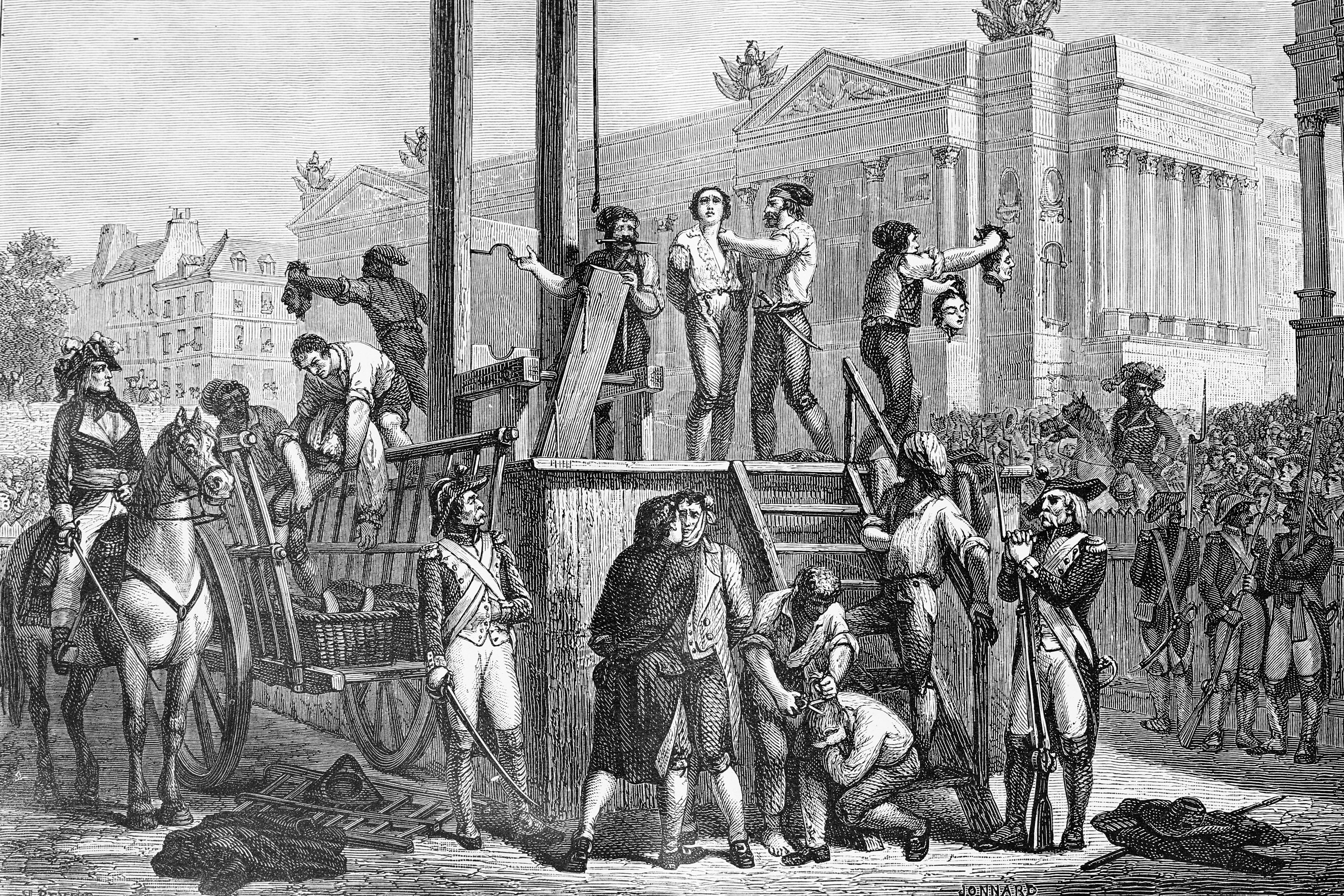
After the Reign of Terror ended, The White Terror began. Vigilantes tracked down and murdered Jacobins and former executioners. A weak coalition government called The Directory tried to restore order, until you know what…
Napoleon showed up.
Napoleon took control. He was a mixed bag. On the one hand, he introduced reforms that laid the foundation for modern democracy. On the other hand, he completely stripped away women’s rights.
Napoleon eradicated freedom of speech and freedom of the press. He put his own family members in charge of the countries he conquered. He locked up his critics and political dissidents without a trial. He plunged Europe into ten years of total war that led to millions of deaths. He committed war crimes as bad as any we’ve seen recently. For example, in Jaffa, he ordered the mass execution of nearly 4,000 prisoners of war because he didn’t want to feed them.
Finally, Napoleon reintroduced slavery to the French colonies and did his best to crush the Haitian Revolution. In the end, Haiti won its independence in 1804 at the cost of 200,000-300,000 lives. Some estimates suggest it was nearly half of their indigenous population. So, that’s the cost of revolution.
That’s what it can take.
The second history lesson
A lot of Americans (and international observers) like to cite the Civil Rights movement as an example of citizen power. They want to know why we can’t do that now. They suggest that Americans today are just lazy, entitled, or uninformed. In reality, it took centuries to build the Civil Rights movement, going all the way back to the foundation of the NAACP in 1909—even earlier. You could say it was a tad more successful than the French Revolution, and a bit less violent.
It was 100+ years in the making.
Historians tend to agree that the American Civil Rights movement succeeded where the French Revolution failed precisely because Civil Rights leaders spent generations building deep, resilient communities and alliances. For them, the community wasn’t a means to an end. It was the whole point.
The French Revolution rushed it, putting ideology first and either abandoning or executing anyone who got in their way. They built fragile communities only to use them as a means to an end.
The Civil Rights movement didn’t start with marches in the 1960s or even the bus boycotts in the 1950s. You have to go back to the early 1900s and even the 1890s. In fact, you could trace the roots of the Civil Rights movement all the way to the foundation of the Bethel AME Church in 1791. The 19th century was filled with conventions, organizations, organized protests, and boycotts. Before Brown v. Board of Education, Benjamin Roberts filed the very first anti-segregation lawsuit in U.S. history. He lost, but he inspired a grassroots movement that led to school integration across Massachusetts in 1855.
It took Frederick Douglass. It took the Harlem Renaissance. It took W.E.B. Du Bois. It took Langston Hughes. It took Nella Larsen. It took Aaron Douglas. It took Richard Wright. It took Ralph Ellison. It took Zora Neale Hurston. It took James Baldwin. It took Rosa Parks. It took Martin Luther King and Malcolm X. It took Thurgood Marshall and John Lewis. It took writers, poets, musicians, artists, organizers, and activists. All of them had different ideas and approaches.
Sometimes, they disagreed.
Churches and schools made up the backbone of the Civil Rights movement, a network started in the 1790s by pioneers who were sick of how they were treated in white churches. The networks grew across hundreds of years, providing spaces for ordinary people to form deep social bonds over generations. It was decades of showing up to help each other and build things together. It ran across the entire country, every city, every town, every neighborhood. That’s how you get the power of a movement that can change things across a country this size.
It’s slow, until it’s not.
When Martin Luther King famously said the moral arc of the universe is long but it bends toward justice, he was drawing from an 1853 sermon by Theodore Parker who used the same metaphor. That was the meaning.
So when I say we’re not ready for a revolution, that’s what I mean. We have a lot of heavy lifting to put in. We have a lot of damage to repair. It’s not always about marching in the street. It’s often about just taking care of people and making them feel seen, respected, even loved.
If you want to run a marathon, you have to get in shape.
Unity and solidarity are more than cheat codes to make other people do what you want them to do. It means you have to change, too.
You have to give.
Before you get to the boycotts and protests, you have to build the bonds. You have to build the friendships. You have to build the communities. You change the world along the way, every step. It’s radical and it’s incremental. It’s also harder than ever. More obstacles than ever. I’m not saying we need churches, but we need something more than our phones and our snark. You have to show people you care about them. You have to do that for years and years.
You can’t fastforward to the revolution.
Even as the world barrels toward climate hell, we have to take this steady approach. I don’t think there’s any other way to do it. Go to your protests. Organize your boycotts. Don’t forget to take care of people. For some of us, that’s a full time job, it’s a lifelong commitment, and it’s even more important. Understand that a movement draws its power from generations of love and support and mutual respect.
You say you want a revolution?
Well, you know…
“but we need something more than our phones and our snark” — brilliant
This aging hippie peacenik remembers a related song from that time: "Won't Get Fooled Again," by the Who. "Meet the new boss, same as the old boss."🎶